

For many overseas-qualified dentists, the ORE exam is the main pathway to practising dentistry in the UK.
The exam assesses whether candidates have the knowledge and skills expected of a newly qualified UK dentist. It also evaluates professional judgment and patient management.
The examination is administered by the General Dental Council (GDC). Candidates who successfully complete both parts of the assessment can apply for GDC registration.
The process requires careful planning. Candidates must meet eligibility requirements, prepare for multiple assessments and complete the registration process.
What Is the ORE Exam?
The Overseas Registration Examination is a professional licensing exam for dentists who qualified outside the UK.
Its purpose is to ensure that all dentists joining the UK register meet the same professional standards. This helps maintain patient safety and consistency across the profession.
The exam is divided into two parts:
- ORE Part 1, which tests theoretical knowledge.
- ORE Part 2, which assesses practical and clinical skills.
Candidates must pass Part 1 before they can attempt Part 2.
Who Needs to Take the ORE Exam?
The ORE is designed for dentists whose qualifications are not accepted for direct registration in the UK.
Many international graduates use this route to obtain UK dental registration. However, eligibility depends on an individual’s qualifications and circumstances. Under current regulations, EU/EEA-qualified students and graduates are exempt from the ORE.
The exam is commonly taken by:
- Dental professionals who trained outside of the UK and the EU/EEA regions.
- International dental graduates
- Professionals planning a dental career in the UK
- Dentists seeking opportunities in NHS or private practice
Recent correspondence from the Department of Health and Social Care provides additional context on the future of the EU qualification exemption from the ORE.
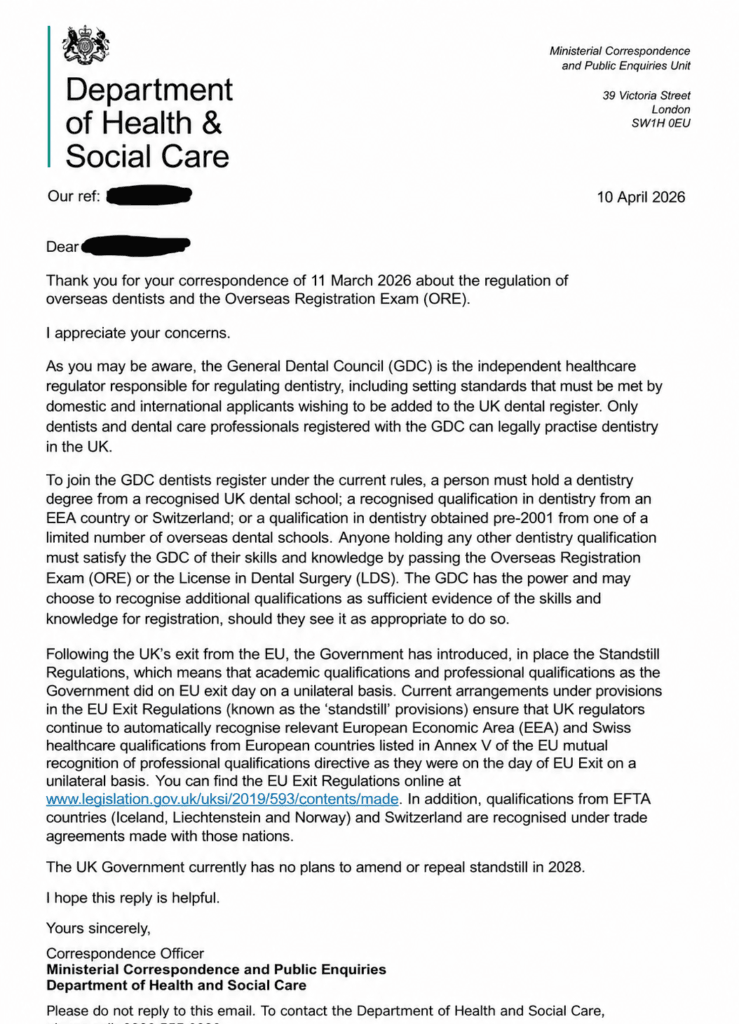
The Email image shows a Department of Health and Social Care response dated 10 April 2026, issued following a Freedom of Information (FOI) request concerning the future recognition of EU dental qualifications in the UK. The response states that there are currently no plans to amend or repeal the standstill arrangements in 2028, meaning eligible EU-qualified dentists would continue to benefit from qualification recognition without being required to sit the ORE.
ORE Exam Dates
The GDC publishes examination schedules throughout the year.
Candidates should check official updates regularly. Examination places can fill quickly after registration opens.
ORE Part 1 Dates:
- 25-26 August 2026
- 14-15 October 2026
ORE Part 2 Dates:
- 10-13 September 2026
- 26-29 November 2026
ORE Exam Fees and Costs
When planning for the examination, it is important to consider both the official fees and additional expenses.
Official Fees
Candidates must pay separate fees for both parts:
- ORE Part 1 Fee: £584
- ORE Part 2 Fee: £6,967
A processing fee of £96 is also required for the ORE application. This fee is payable at the time of submitting your application via the eGDC portal.
The GDC reviews fees periodically, so candidates should check the latest fee schedule before applying.
Additional Costs
Many candidates also budget for:
- English language tests
- Study materials
- Preparation courses
- Travel expenses
- Accommodation
- Visa-related costs
ORE Eligibility Requirements
Before applying, candidates must meet the ORE eligibility requirements set by the GDC.
These requirements focus on three key areas:
- Educational qualifications
- English language proficiency
- Professional suitability
Understanding the ORE Exam Structure
The examination consists of two separate assessments. Each part measures different aspects of professional competence.
Part 1 focuses on knowledge and clinical reasoning. Part 2 focuses on practical skills and patient management.
ORE Part 1
ORE Part 1 is the first stage of the examination. It assesses the knowledge expected of a newly qualified dentist in the UK.
The assessment is computer-based and consists of multiple-choice questions. These questions test a candidate’s understanding of dental science, clinical practice and professional responsibilities.
The examination is divided into two papers:
- Part A: Clinically Applied Dental Science and Human Disease
- Part B: Clinical Dentistry, Law, Ethics and Safety
Part 1 is typically conducted at King’s College London. However, candidates should always check the latest guidance from the General Dental Council (GDC), as examination arrangements may change.
Results are usually issued by email within 30 working days of the examination date.
The GDC generally allows up to 600 candidates per sitting of Part 1. Candidates are permitted a maximum of four attempts to pass ORE Part 1.
ORE Part 2
After passing ORE Part 1, candidates can progress to ORE Part 2. This stage assesses practical skills, clinical judgement and patient management in simulated clinical scenarios.
Exam Structure
Part 2 consists of four assessment components:
Objective Structured Clinical Examination (OSCE)
The objective structured clinical examination (OSCE) assesses clinical and professional skills through a series of stations.
Topics may include:
- Dental law and ethics
- Professionalism
- Human disease
- Clinical dentistry
- Oral surgery
- Restorative dentistry
- Paediatric dentistry
- Orthodontics
- Dental radiology
Candidates are assessed on communication, history taking, clinical assessment and professional judgement.
Dental Manikin Operative Test
Candidates complete three clinical procedures on a dental manikin within three hours.
This component assesses operative skills, accuracy and clinical technique.
Diagnostic and Treatment Planning Exercise
Candidates review a patient case using materials such as radiographs, photographs, study models and clinical records.
They must identify the problem, reach a diagnosis and develop an appropriate treatment plan.
Medical Emergencies Assessment
This assessment includes a scenario-based oral examination and a demonstration of basic life support, including CPR on a resuscitation manikin.
Examination Venues
Part 2 is usually conducted at several venues in London, including:
- The Royal College of Surgeons of England (OSCE)
- UCL Eastman Dental Institute (Dental Manikin Test)
- Eastman Dental Hospital Education Centre (DTP and Medical Emergencies)
Results and Attempts
Part 2 is typically limited to 144 candidates per examination cycle. Results are usually emailed within 20 working days of the examination.
Candidates are permitted a maximum of four attempts at ORE Part 2.
ORE 2025 Pass Rates
ORE Part 1 (August 2025) recorded a pass rate of 75% for candidates who passed both Part 1(a) and Part 1(b). Individually, the pass rates were 79% for Part 1(a) and 80% for Part 1(b).
ORE Part 2 (November 2025) recorded an overall pass rate of approximately 76%. The exam assesses candidates through the OSCE, Dental Manikin Exercise, Diagnosis and Treatment Planning Exercise, and Medical Emergencies Exercise.
How to Apply for the ORE Exam
The ORE application process begins with confirming your eligibility and preparing the required documents.
While the exact requirements may change, the application process generally follows these steps:
- Check your eligibility with the GDC.
- Gather supporting documents.
- Submit an eligibility application.
- Receive approval from the GDC.
- Book an available examination place.
Once you have completed your ORE application process and the GDC has approved it, you can book your ORE exam spot at: Booking Your Exam
Requirements and Documents for the ORE Exam
Before booking the ORE exam, applicants must meet the eligibility requirements set by the General Dental Council (GDC) and submit the necessary supporting documents.
These typically include:
- A completed application form, including a clinical reference signed by the referee.
- A valid Certificate of Current Professional Status (CCPS) issued within the last three months.
- Proof of English language proficiency.
- An authenticated copy of a recognised dental qualification.
- An authenticated copy of a valid passport.
- One recent passport-sized photograph.
- An ENIC Statement of Comparability.
- Evidence of clinical experience.
Applicants must also demonstrate at least 1,600 hours of clinical experience treating patients in a dental setting. Supporting evidence is requested during the application process.
Common Challenges Faced by Candidates
The ORE process is structured and straightforward, and the main difficulty for most candidates is exam availability rather than the syllabus. There are 3 sittings per year for Part 1 and 4 sittings for Part 2, and places are limited and fill quickly, so early application is important.
The exam covers a wide range of dental topics and requires knowledge of UK clinical standards, but these can be managed with proper preparation.
ORE vs LDS: What’s the Difference?
The ORE is not the only route available to internationally qualified dentists.
Another option is the Licence in Dental Surgery (LDS), offered by the Royal College of Surgeons of England.
Both examinations provide a pathway to registration, but they differ in:
- Examination structure
- Assessment format
- Availability of examination places
- Administrative procedures
Final Thoughts
The ORE exam remains an important pathway for internationally trained dentists seeking UK dental registration.
Understanding the examination structure, eligibility requirements and application process can make preparation more manageable.
Start early, follow a structured study plan and stay informed about GDC updates. With the right preparation, you can approach the examination with confidence and take the next step towards practising dentistry in the UK.
Frequently Asked Questions
Both examinations are challenging. The better option depends on your circumstances, preparation strategy and preferred examination format.
Candidates are allowed up to four attempts for Part 1 and four attempts for Part 2.
No. Passing the examination makes you eligible to apply for GDC registration, but you must still complete the registration process and meet all regulatory requirements.
Yes. Once you make your first attempt at ORE Part 1, you have five years to successfully pass ORE Part 2.
Applicants must demonstrate at least 1,600 hours of clinical experience treating patients in a dental chair.